



Why 24V is the Standard Voltage in Industrial Control Panels
 March 12, 2026
The 24V DC control voltage has become the global standard for industrial automation systems because it offers the right balance between safety, reliability, and performance.
1. Operator Safety
24V circuits significantly reduce the risk of electrical shock for technicians working on control panels during maintenance or troubleshooting.
2. Compatibility with Automation Devices
Most industrial control devices are designed to operate using 24V DC power, including:
- PLC controllers
- Sensors
- Control relays
- Industrial communication modules
Using a standardized voltage simplifies system integration and equipment selection.
3. Reduced Electrical Noise
Compared with higher-voltage AC control circuits, 24V DC systems produce less electromagnetic interference. This improves signal reliability in PLC inputs and communication networks.
4. Industry-Wide Standardization
Because 24V has become a global automation standard, most industrial equipment manufacturers design their devices to operate using 24V control power.
Typical Devices Powered by 24V Control Circuits
A wide range of automation devices operate using 24V control power, including:
- PLC processors and I/O modules
- Proximity sensors
- Limit switches
- Industrial relays
- Solenoid valves
- HMI displays
- Communication modules
Using a single standardized voltage simplifies wiring and system maintenance.
Power Architecture of an Industrial Control Panel
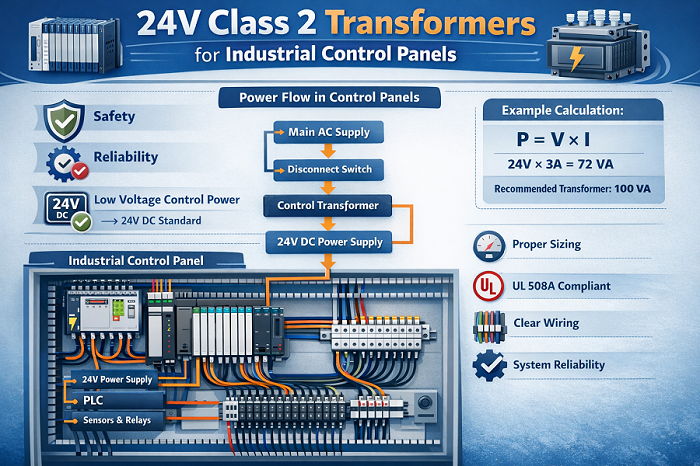
Industrial control panels follow a structured power distribution architecture to ensure safe and reliable operation.
Standard Power Flow
Main AC Supply
↓
Main Disconnect Switch
↓
Circuit Breaker
↓
Control Transformer
↓
24V DC Power Supply
↓
Terminal Blocks
↓
PLC and Field Devices
This design ensures that high-voltage power is safely converted into low-voltage control power for automation equipment.
Key Components in the Power System
Main Disconnect Switch
Allows technicians to isolate the entire control panel from the electrical supply during maintenance or emergency shutdown.
Circuit Breakers
Protect circuits from overloads and short circuits.
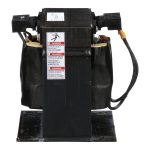
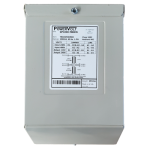
Control Transformer
Steps down incoming voltage to a lower level suitable for control circuits.
24V Power Supply
Converts AC voltage into stable 24V DC power required by automation devices.
Terminal Blocks
Distribute power to PLC systems, sensors, and field devices.
How to Size a 24V Class 2 Transformer
Correct transformer sizing is critical to ensure stable operation and prevent power supply failures.
Step 1: List All Electrical Loads
Identify all devices that require 24V power and calculate the total current.
Example:
Total load current = 3A
Step 2: Add a Safety Margin
A safety margin of 25–30% should always be added to account for:
- Startup currents
- System expansion
- Power fluctuations
Example:
3A × 1.3 = 3.9A
Step 3: Convert Current to VA Rating
The required transformer capacity can be calculated using the electrical power equation:
P = V \times I
Example calculation:
24V × 3A = 72 VA
Recommended Transformer Size
To ensure sufficient capacity, a 100 VA Class 2 transformer would be a suitable choice.
Wiring a 24V Class 2 Transformer in Control Panels
Correct wiring is essential for safety and reliability.
Typical Wiring Procedure
- Connect the transformer primary winding to the incoming AC supply
- Protect the primary circuit with a miniature circuit breaker
- Connect the transformer secondary output to the 24V power supply
- Distribute 24V power through terminal blocks
- Label all circuits clearly for maintenance
Wiring Best Practices
When designing control panel wiring, follow these best practices:
- Separate control wiring from power wiring
- Ensure proper grounding of the system
- Use ferrules on wire ends for secure connections
- Select appropriate wire gauge based on current
- Clearly label wires and terminal blocks
These practices improve system reliability and simplify maintenance.
Advantages of Class 2 Power Transformers
Using Class 2 power transformers in industrial control panels offers several important benefits.
Enhanced Safety
Limited power output significantly reduces fire hazards and shock risks.
Simplified Wiring
Lower power levels allow simpler wiring methods.
Easier Regulatory Compliance
Class 2 circuits simplify compliance with industrial electrical standards.
Improved Maintenance Safety
Technicians can safely troubleshoot low-voltage control circuits.
Common Mistakes in Control Panel Power Design
Several common design mistakes can affect system performance.
Incorrect Transformer Sizing
An undersized transformer may cause voltage drops and unstable PLC operation.
No Load Margin
Without extra capacity, future system expansion becomes difficult.
Poor Grounding
Improper grounding can introduce electrical noise and communication errors.
Mixing AC and DC Wiring
Running AC and DC wires together can create electromagnetic interference.
Poor Wire Organization
Messy wiring can increase troubleshooting time and create overheating risks.
Electrical Compliance for Industrial Control Panels
Industrial control panels must comply with recognized electrical standards to ensure safe operation.
Important standards include:
- UL 508A – Industrial Control Panels
- NEC Article 725 – Class 2 and Class 3 Circuits
- UL 1310 – Class 2 Power Units
Key compliance requirements include:
- Proper circuit protection
- Correct wiring methods
- Accurate labeling and documentation
- Power limitation for Class 2 circuits
Following these standards ensures safe installation and easier system certification.
Example Industrial Control Panel Power Design
Consider a packaging machine control system.
Typical Power Structure
480V AC Input
↓
Step-Down Transformer
↓
24V Class 2 Power Supply
↓
PLC System
↓
Sensors and Actuators
This design safely converts high-voltage power into a low-voltage control system used by automation devices.
When to Use Multiple 24V Power Supplies
Large automation systems often require multiple 24V power supplies.
Situations where multiple supplies are recommended include:
- Large industrial automation systems
- Separation of PLC and field device power
- Redundant power systems for critical processes
- Noise isolation between different control circuits
Separating loads improves stability and simplifies troubleshooting.
Best Practices for Reliable Control Panel Power Systems
To design a reliable control panel power system, consider the following best practices:
- Maintain at least 30% load margin
- Use industrial DIN-rail mounted power supplies
- Separate PLC and field device power circuits
- Install surge protection devices
- Include diagnostic indicators on power supplies
- Clearly label wires and terminals
- Use redundant power supplies in critical systems
These practices significantly improve reliability and reduce downtime.
Key Takeaways
- 24V Class 2 transformers are widely used in industrial automation systems.
- They provide limited power output for improved safety.
- Proper transformer sizing ensures stable PLC operation.
- Compliance with electrical standards is critical for safe panel design.
- A well-designed control power system improves reliability, safety, and maintainability.
Frequently Asked Questions
Q: What is a Class 2 transformer?
A: A Class 2 transformer is a power supply designed to provide limited electrical power, reducing fire and electrical shock risks in control circuits.
Q: Why is 24V used in PLC systems?
A: 24V DC offers the best balance between safety, electrical noise immunity, and compatibility with automation equipment.
Q: What happens if a transformer is undersized?
An undersized transformer may cause:
- Voltage drops
- PLC resets
- System instability
- Transformer overheating
Proper load calculation prevents these issues.
Q: Can Class 2 circuits power motors?
A: No. Class 2 circuits are intended for low-power control devices, not high-power equipment such as motors.
Power Your Industrial Control Systems
Powervolt Group specializes in designing and manufacturing high-performance transformers for industrial automation, control panels, and OEM equipment. With decades of engineering expertise and strict quality standards, Powervolt delivers reliable power solutions trusted by manufacturers worldwide.
Contact us today to discuss your transformer needs or explore our solutions: https://powervoltgroup.com