

5 Signs Your Transformer Winding Is Failing – And What to Do About It
 May 15, 2026
Every transformer winding has a lifespan. And when it starts to fail, it rarely announces itself with a dramatic explosion.
Instead, it gives you quiet warning signs – small symptoms that, if caught early, can save your business from costly downtime, equipment damage, or even dangerous electrical failures.
At Powervolt Group, we’ve inspected, repaired, and rewound transformers across industries for years.
We’ve seen what happens when warning signs are ignored – and what happens when they’re caught in time. This guide is built on that experience.
Whether you manage a factory, a power substation, a commercial building, or an industrial plant, this article will help you identify the early warning signs of transformer winding failure before they become full-blown emergencies.
What Is Transformer Winding – And Why Does It Fail?
Transformer winding refers to the coils of copper or aluminum wire wound around a magnetic core inside a transformer.
These windings – a primary winding and a secondary winding – work together through electromagnetic induction to transfer electrical energy from one voltage level to another.
When a transformer winding begins to fail, the entire energy transfer process is compromised. Voltage becomes unstable.
Heat builds up. Insulation breaks down. And eventually, the transformer can fail completely.
Common root causes of winding failure include:
- Prolonged overloading beyond rated capacity
- Overheating and thermal stress over time
- Moisture ingress into the insulation system
- Short circuits or voltage surges from the grid
- Age-related insulation degradation
- Poor-quality materials used during manufacturing or rewinding
- Loose connections causing arcing and localized heating
Knowing why windings fail helps you recognise when they are failing. Let’s get into the signs.
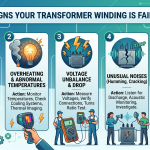
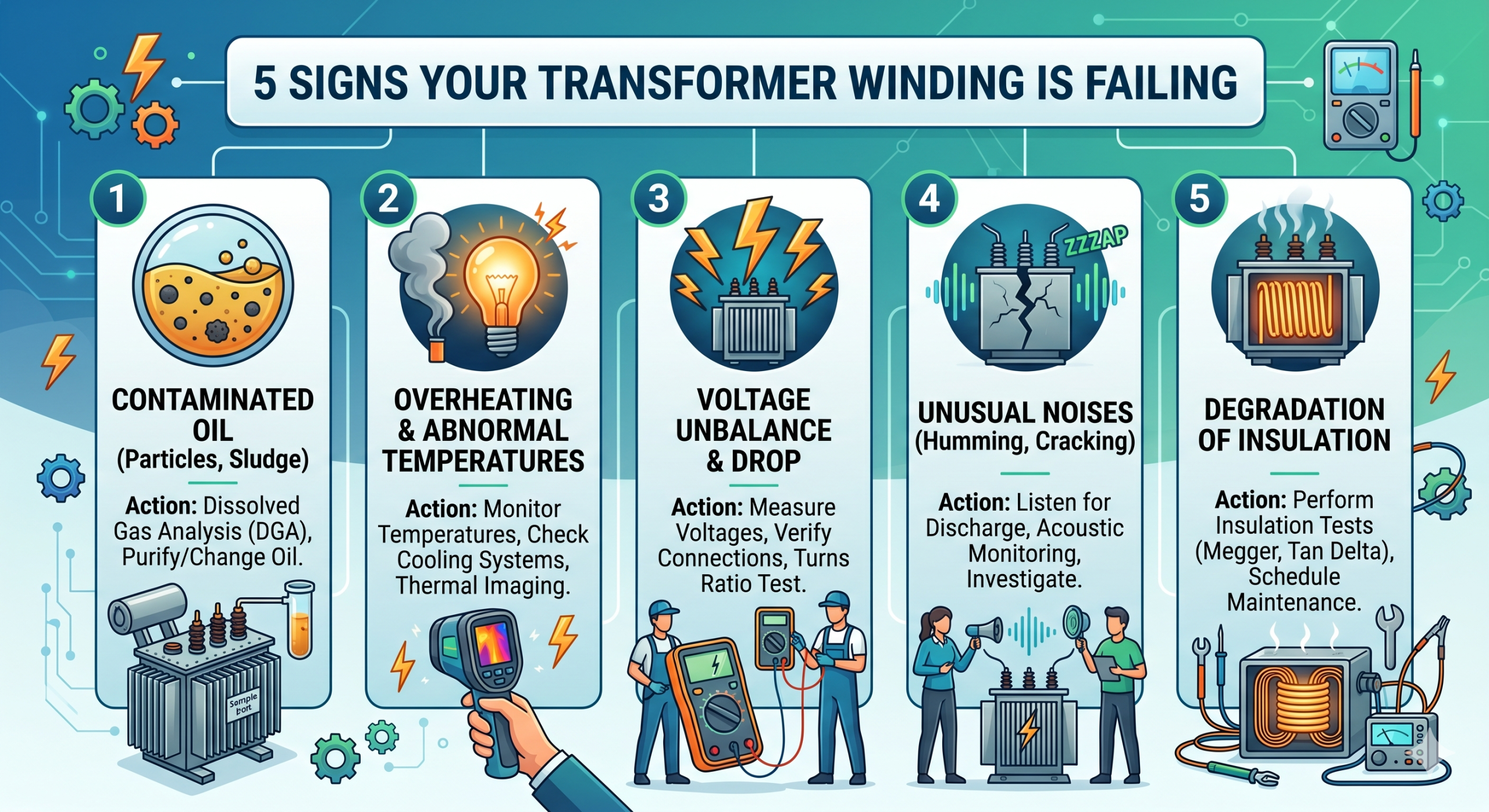
Sign #1: Unusual Heat or Overheating
What to look for:
Your transformer feels excessively hot to the touch. The ambient temperature around the unit is noticeably higher than usual. Temperature monitoring equipment – if installed – is showing readings above the transformer’s rated temperature rise limit.
Why this happens:
Heat is the number one enemy of transformer insulation. As winding insulation degrades, electrical resistance in the winding increases. Higher resistance generates more heat. More heat accelerates insulation breakdown further – it’s a destructive cycle.
According to the Arrhenius Rule of transformer ageing, every 8–10°C rise in operating temperature above the rated limit can cut the insulation’s lifespan in half. A transformer running 20°C above its design temperature could age four times faster than expected.
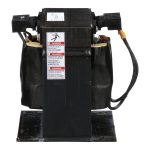
This is especially critical in Industrial Control Transformers, where compact winding designs leave less thermal margin for error.
What to do:
- Check your transformer’s name plate for its insulation class and rated temperature rise
- Compare current operating temperature against rated limits
- Inspect cooling systems – oil levels, cooling fans, or radiators – for blockages or failure
- If overheating is confirmed, reduce load immediately and schedule a winding resistance test
- Contact a transformer expert like Powervolt Group for a thermal inspection
Do not ignore overheating. It is the most common precursor to full winding failure and insulation breakdown.
Sign #2: Humming, Buzzing, or Unusual Noise
What to look for:
All transformers produce a low hum during normal operation – this is normal and caused by magnetostriction in the core. However, if the sound has become significantly louder, changed in pitch, or developed into a buzzing, crackling, or rattling noise, something is wrong.
Why this happens:
Unusual noise from a transformer can indicate several winding-related issues:
- Loose winding conductors vibrating under electromagnetic forces
- Partial discharge – small electrical sparks occurring within degraded insulation
- Winding deformation caused by a short-circuit event that distorted the coil geometry
- Interlaminar insulation failure between winding layers causing internal arcing
Partial discharge in particular is a serious warning sign. It produces a distinctive crackling or hissing sound and can be detected with ultrasonic testing equipment even before it causes visible damage.
What to do:
- Compare the sound to what was normal when the transformer was new or last serviced
- Use an ultrasonic detector to check for partial discharge activity
- Arrange a Sweep Frequency Response Analysis (SFRA) test to check for winding deformation
- Do not continue operating at full load if crackling or intermittent buzzing is heard
Sign #3: Voltage Fluctuations or Unstable Output
What to look for:
Equipment connected to your transformer begins showing performance issues. Lights flicker. Motors run erratically. Sensitive electronics experience unexpected resets or malfunctions. Voltage readings on meters are inconsistent or outside expected tolerances.
Why this happens:
The transformer winding’s turns ratio – the number of turns on the primary winding compared to the secondary – determines the output voltage. When windings are healthy, this ratio is stable and consistent.
When winding insulation breaks down between adjacent turns (called a shorted turn or inter-turn fault), the effective turns ratio changes.
This directly causes output voltage to shift unpredictably. The transformer may also struggle to maintain voltage under varying load – a problem known as poor voltage regulation.
Inter-turn faults are particularly dangerous because:
- They can be hard to detect without proper testing
- They create localised hotspots that accelerate further insulation damage
- They can quickly escalate to a full winding fault if not addressed
In applications using Standard Series GP Transformers, even minor inter-turn faults can cause significant voltage deviation across connected control circuits.
What to do:
- Measure output voltage under different load conditions and compare to rated values
- Perform a Turns Ratio Test (TTR) – this directly reveals whether the winding ratio has shifted
- Perform a winding resistance test using a low-resistance ohmmeter (DLRO) to identify damaged conductors or connections
- If shorted turns are confirmed, the winding likely needs rewinding or replacement
Sign #4: Burning Smell or Visible Discolouration
What to look for:
A distinctive burnt smell – similar to burning plastic or rubber – coming from the transformer enclosure. When inspected (safely), you may observe:
- Discolouration or darkening of winding insulation (brown, black, or charred areas)
- Blistering or cracking of the insulation coating on winding conductors
- Carbonisation or burn marks on winding surfaces
- Discoloured or darkened transformer oil in oil-immersed units
Why this happens:
The insulation wrapped around each winding conductor – whether it’s enamel coating, paper, varnish, or synthetic film – is what prevents short circuits between turns. When this insulation overheats or is exposed to excessive voltage, it burns.
Once insulation carbonises, its electrical resistance drops dramatically. What was an insulating barrier becomes a conducting path, allowing current to flow where it shouldn’t. This is how inter-turn shorts and winding-to-core faults develop.
In oil-immersed transformers, burning insulation releases gases into the oil. A Dissolved Gas Analysis (DGA) test can detect these gases – including hydrogen, acetylene, and ethylene – as early indicators of insulation breakdown before visible burning is even evident.
What to do:
- Never ignore a burning smell from an electrical transformer – shut it down immediately if the smell is strong or persistent
- Perform a visual inspection of the winding insulation for discolouration or physical damage
- For oil-immersed transformers, send an oil sample for DGA testing immediately
- Conduct insulation resistance (IR/Megger) testing to measure insulation health
- If insulation damage is confirmed, do not return to service without professional assessment
Sign #5: Tripping, Breaker Faults, or Differential Relay Operation
What to look for:
Your transformer is tripping its protection relay or circuit breaker repeatedly – especially the differential protection relay, which is specifically designed to detect internal faults. The transformer may also cause upstream breakers to trip under normal operating loads.
Why this happens:
Transformer protection relays continuously compare the current entering the primary winding to the current leaving the secondary winding. Under normal operation, these should be proportional and balanced.
When a winding fault develops – such as a turn-to-turn short, a winding-to-earth fault, or a winding-to-core fault – the current balance is disrupted. The differential relay detects this imbalance and trips the transformer to prevent further damage.
Repeated relay trips are never a nuisance – they are the protection system doing exactly its job. Resetting the breaker and returning the transformer to service without investigation is one of the most dangerous mistakes in transformer maintenance.
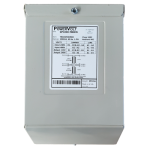
Protection relay trips are particularly disruptive in panel-mounted Enclosed Control Transformers, where access for inspection is limited and downtime impacts entire control systems.
Other protection devices that may operate during winding failure include:
- Buchholz relay (in oil-immersed transformers) – detects gas build-up from internal arcing
- Winding temperature indicators – trip at preset temperature thresholds
- Overcurrent relays – operate when fault currents exceed rated thresholds
What to do:
- Do not automatically reset and re-energise a transformer that has tripped on differential protection
- Review relay event logs to understand what triggered the trip
- Perform insulation resistance testing, winding resistance testing, and turns ratio testing before re-energising
- If the Buchholz relay has operated, collect a gas sample and send for analysis
- Engage a qualified transformer testing or repair company to assess internal condition
What Happens If You Ignore These Signs?
Ignoring early winding failure signals doesn’t make the problem go away – it accelerates it. Here’s the typical progression:
| Stage | What’s Happening | Consequence |
| Early | Insulation degrading, minor overheating | Reduced lifespan, inefficiency |
| Middle | Inter-turn faults, partial discharge | Voltage instability, equipment damage |
| Late | Full winding fault, relay trips | Transformer shutdown, costly repairs |
| Critical | Catastrophic failure, fire risk | Total replacement, safety hazard |
Catching the problem at Stage 1 or 2 typically means a rewind or repair. Catching it at Stage 3 or 4 often means complete transformer replacement – at five to ten times the cost.
Key Tests Used to Diagnose Transformer Winding Health
When any of the above signs appear, these are the standard diagnostic tests used by professionals:
Winding Resistance Test Measures the DC resistance of each winding. Detects broken strands, loose connections, and damaged conductors.
Turns Ratio Test (TTR) Compares the actual turns ratio to the nameplate value. Identifies shorted turns and winding damage.
Insulation Resistance Test (Megger Test) Applies a high DC voltage to measure insulation resistance. Indicates moisture, contamination, or degradation.
Sweep Frequency Response Analysis (SFRA) Compares the transformer’s frequency response fingerprint to a baseline. Detects physical deformation of windings caused by short circuits or mechanical stress.
Dissolved Gas Analysis (DGA) For oil-filled transformers. Identifies gases produced by overheating or arcing inside the transformer.
Power Factor / Dissipation Factor Test Evaluates the overall health of the transformer insulation system.
When to Call a Transformer Winding Expert
You should contact a professional transformer winding specialist immediately if:
- Your transformer has tripped on differential or Buchholz protection
- You detect a burning smell or see visible damage to insulation
- Output voltage is unstable or deviating significantly from rated values
- The transformer is running 15°C or more above its rated temperature rise
- Insulation resistance readings have dropped significantly from previous tests
- Your transformer is more than 20 years old and has never been rewound or inspected internally
How Powervolt Group Can Help
At Powervolt Group, we specialise in transformer winding inspection, testing, repair, and custom rewinding for distribution and power transformers across industrial, commercial, and utility applications.
Our services include:
- On-site transformer diagnostic testing – winding resistance, TTR, Megger, SFRA
- Transformer rewinding – using high-grade copper conductors and premium insulation materials
- Custom winding solutions – designed to meet your specific voltage, current, and environmental requirements
- Emergency transformer repair – fast turnaround to minimise your downtime
We understand that transformer failure doesn’t wait for convenient timing. That’s why our team is equipped to respond quickly, assess accurately, and restore your transformer to full performance – or build you a better one.
Final Thoughts
Transformer winding failure is rarely sudden. It gives you warnings. The five signs covered in this article – overheating, unusual noise, voltage fluctuation, burning smell, and protection relay trips – are your transformer’s way of asking for help.
The businesses that catch these signs early save time, money, and equipment. The ones that don’t often face emergency shutdowns at the worst possible moment.
Looking for a cost-effective replacement after a winding failure? Our Econoline Series GP Transformers are designed for reliable performance at competitive value.
If your transformer is showing any of these signs, don’t wait.Contact Powervolt Group today for a professional transformer winding assessment. Our experts are ready to help you diagnose the problem, plan the repair, and get your operations back to full power.