



Industrial Control Transformers for PLCs: Common Design Errors
 January 13, 2026
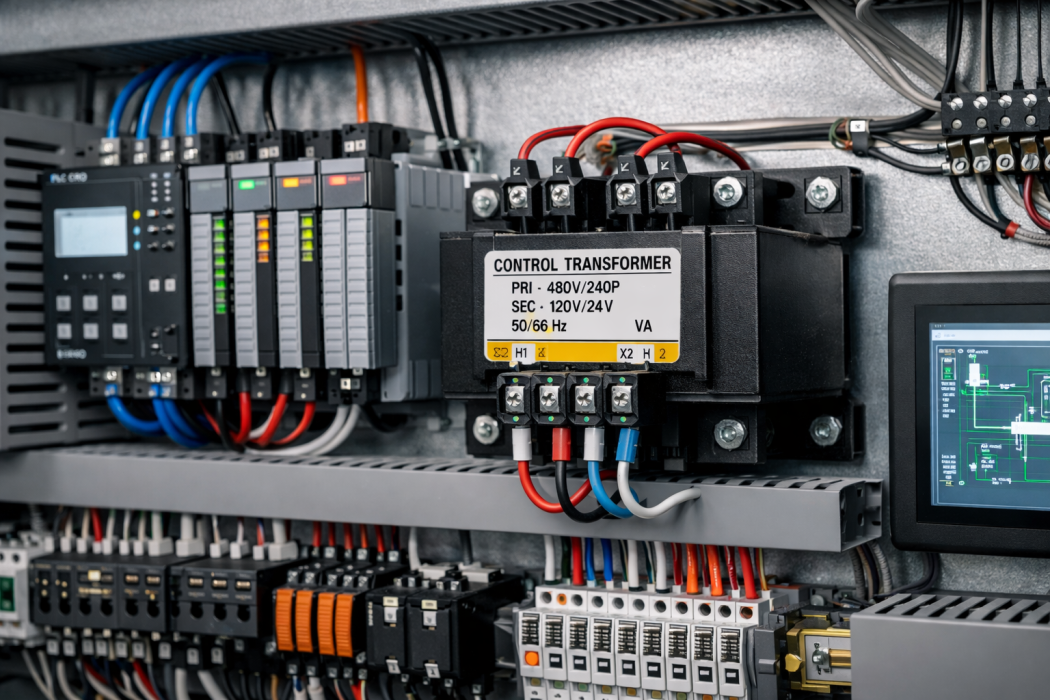
PLCs are the backbone of modern automation—but they are extremely sensitive to power quality. Many PLC failures are not caused by the PLC itself, but by design errors in Industrial Control Transformers.
Understanding these mistakes can dramatically improve system reliability.
Start with the big picture here:
Common Mistakes to Avoid When Selecting Industrial Control Transformers
Why PLC Systems Need Proper Industrial Control Transformers
PLCs require:
- Stable voltage
- Noise-free power
- Proper grounding
- Adequate inrush capacity
Generic or incorrectly designed transformers often fail to meet these requirements.
Common PLC-Related Transformer Design Errors
1. Selecting the Wrong Secondary Voltage
PLC control circuits typically operate at 24V AC or DC, but many systems still use:
- 120V AC control power
- Mixed-voltage control architectures
Common Errors
- Using the wrong secondary voltage for PLC I/O modules
- Assuming all devices can tolerate voltage variation
- Not accounting for voltage drop over long wire runs
Incorrect voltage levels can:
- Damage PLC inputs
- Cause logic faults
- Reduce lifespan
What voltage transformer should I use for a PLC?
2. Ignoring Electrical Noise and Grounding
Industrial environments are electrically noisy. Without proper isolation, noise can enter the PLC through the control transformer.
Risks
- False inputs and erratic PLC behavior
- Communication errors
- Damage to sensitive electronics
Powervolt Group designs transformers with grounding considerations specifically for PLC environments.
3. Not Accounting for PLC Expansion
Many control panels are designed without considering future I/O modules, HMIs, or sensors—leading to transformer overload later. PLC systems tend to grow over time.
Typical Scenario
A transformer sized perfectly for today’s PLC configuration becomes inadequate when:
- Control logic expands
- New I/O modules are added
- Additional HMIs or sensors are installed
This often results in undersizing, explained in detail here:
Why Undersizing Industrial Control Transformers Causes System Failures\
4. Ignoring Control Circuit Inrush Current
Contactors and relays connected to PLC outputs can draw 5–10 times their rated current during energization.
If the transformer cannot support this momentary demand:
- PLC output cards may fault
- Control voltage may collapse briefly
- Contactors may chatter or fail to pull in
Select transformers specifically designed for industrial control applications, which are built to handle short-term inrush loads without excessive voltage drop.
5. Using General-Purpose Transformers
Not all transformers are suitable for PLC control power. General-purpose transformers may:
- Offer inadequate isolation for control circuits
- Lack sufficient inrush capability
- Have higher voltage regulation variance
Always specify industrial control transformers designed for automation, PLCs, and control panels.
Best Practices for PLC Transformer Design
- Choose control-grade transformers
- Provide VA headroom for expansion
- Ensure proper grounding
- Match voltage precisely
- Use industrial insulation classes
Optimize Your PLC Panel Design
Consult Powervolt Group for PLC transformer selection.
FAQs
Can a transformer cause PLC communication errors?
Yes. Voltage instability and electrical noise are common causes.
Should PLCs use separate control transformers?
Yes. Dedicated transformers improve power quality and isolation.
Are industrial control transformers mandatory for PLC panels?
While not always mandatory, they are strongly recommended for reliability and safety.
How does transformer quality affect PLC lifespan?
Stable, noise-free power significantly extends PLC operational life.
Final Thoughts
If you’re designing or upgrading a PLC control panel, investing time in proper transformer selection is not optional—it’s essential.
Avoiding these common errors will help you:
- Reduce nuisance PLC faults
- Improve system uptime
- Extend the life of control components
- Deliver more reliable automation systems