







Stray Losses in Power Transformers: Causes & Reduction Techniques
 April 2, 2026
Power transformers are the backbone of modern electrical systems, ensuring efficient transmission and distribution of electricity.
While much attention is given to core losses and copper losses, stray losses often remain less understood – yet they can significantly impact transformer performance, efficiency, and lifespan.
In this blog, we’ll break down what stray losses are, their causes, and the most effective techniques to reduce them – so you can optimize transformer performance and minimize energy waste.
What Are Stray Losses in Power Transformers?
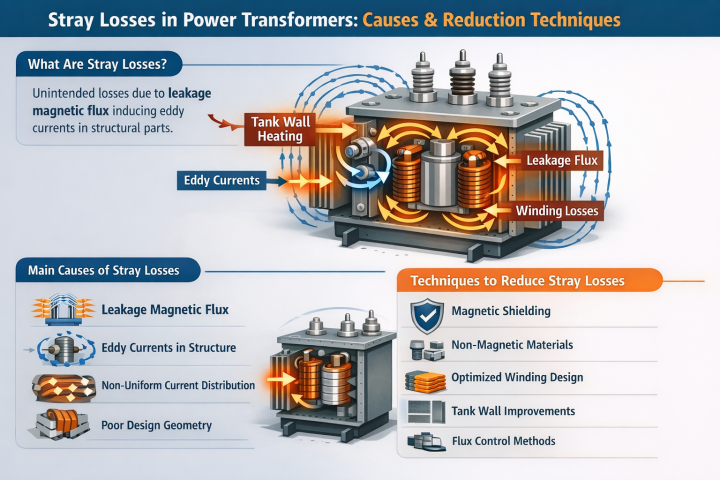
Stray losses are unintended losses caused by leakage magnetic flux that does not follow the designed magnetic path within a transformer. Unlike core and copper losses, stray losses occur in structural components such as:
- Tank walls
- Clamping structures
- Bolts and fasteners
- Windings (due to eddy currents)
These losses convert electrical energy into heat, which can reduce efficiency and contribute to localized overheating.
Why Do Stray Losses Matter?
Even though stray losses may seem minor, they can:
- Reduce overall transformer efficiency
- Increase operating temperature
- Accelerate insulation aging
- Lead to higher cooling requirements
- Increase operational costs over time
In high-capacity transformers, stray losses can account for a significant percentage of total losses, making them critical to address.
Main Causes of Stray Losses
Understanding the root causes helps in designing effective mitigation strategies.
1. Leakage Magnetic Flux
Not all magnetic flux stays confined within the transformer core. Some “leaks” into surrounding structures, inducing eddy currents in metallic parts.
2. Eddy Currents in Structural Components
When leakage flux passes through conductive materials like steel tanks or clamps, it induces circulating currents. These currents generate heat and cause power loss.
3. Non-Uniform Current Distribution
High-frequency harmonics and load variations can lead to uneven current distribution in windings, increasing stray losses.
4. Poor Design Geometry
Improper placement of windings or structural parts can intensify leakage flux paths, leading to higher losses.
5. High Load Conditions
At higher loads, leakage flux increases, which directly amplifies stray losses.
Types of Stray Losses
Stray losses can be broadly classified into:
1. Winding Stray Losses
- Caused by eddy currents in conductors
- Increase with load current
- Influenced by conductor size and arrangement
2. Structural Stray Losses
- Occur in transformer tank, clamps, and frame
- Caused by leakage flux interacting with metallic parts
3. Other Miscellaneous Losses
- Losses in leads and connections
- Losses due to magnetic field distortion
Techniques to Reduce Stray Losses
Reducing stray losses requires a combination of smart design, material selection, and advanced engineering techniques.
1. Magnetic Shielding
Installing magnetic shields around critical components helps redirect leakage flux away from structural parts.
Benefits:
- Reduces eddy current formation
- Minimizes heating in tank walls
2. Use of Non-Magnetic Materials
Replacing ferromagnetic components with non-magnetic materials (like stainless steel or aluminum) reduces induced currents.
Common applications:
- Bolts
- Clamping plates
- Structural supports
3. Optimized Winding Design
Proper arrangement and transposition of windings can significantly reduce leakage flux.
Key practices:
- Use of continuously transposed conductors (CTC)
- Proper spacing between windings
- Balanced current distribution
4. Tank Wall Design Improvements
Transformer tanks can be designed to minimize stray losses through:
- Laminated shielding
- Insulated panels
- Flux diverters
5. Flux Control Techniques
Engineers can control leakage flux paths by:
- Adding magnetic shunts
- Designing core geometry carefully
- Using flux barriers
6. Advanced Simulation Tools
Modern transformer design relies heavily on simulation software like finite element analysis (FEA).
Advantages:
- Predicts stray losses accurately
- Helps optimize design before manufacturing
- Reduces trial-and-error costs
7. Improved Cooling Systems
Although not a direct reduction method, effective cooling systems help manage heat generated by stray losses.
Examples:
- Oil cooling
- Forced air systems
- Radiators
8. Proper Load Management
Operating transformers within rated capacity helps limit excessive leakage flux and associated losses.
To fully understand transformer performance beyond losses, it’s essential to explore reliability-focused design principles.
What Factors Affect Reliability in Low Voltage Power Transformer Design?
This pillar topic covers critical aspects such as insulation systems, thermal management, material quality, load handling, and fault tolerance – helping you design transformers that are not only efficient but also durable and dependable in real-world conditions.
Real-World Impact of Reducing Stray Losses
Reducing stray losses can deliver measurable benefits:
- Higher efficiency: Less wasted energy
- Longer lifespan: Reduced thermal stress
- Lower maintenance costs: Less overheating damage
- Improved reliability: Stable operation under varying loads
In large power systems, even a small percentage reduction in stray losses can lead to significant energy savings over time.
Future Trends in Stray Loss Reduction
The industry is moving toward smarter and more efficient transformer designs:
- AI-based optimization of transformer geometry
- Use of advanced composite materials
- Real-time monitoring of losses
- Smart grid integration
These innovations aim to minimize losses while maximizing performance and sustainability.
Frequently Asked Questions (FAQs)
1. What is the difference between stray losses and copper losses?
Copper losses occur due to resistance in windings, while stray losses are caused by leakage flux inducing currents in unintended parts of the transformer.
2. Can stray losses be completely eliminated?
No, but they can be significantly reduced through proper design and materials.
3. Do stray losses increase with load?
Yes, stray losses generally increase with load because leakage flux becomes stronger.
4. How are stray losses measured?
They are typically calculated indirectly through testing and advanced simulation methods like finite element analysis.
5. Why are stray losses important in large transformers?
In high-capacity transformers, stray losses can contribute significantly to total losses, affecting efficiency and operating costs.
Conclusion
Stray losses may not always be visible, but their impact on transformer efficiency and longevity is undeniable.
By understanding their causes and implementing effective reduction techniques – such as optimized winding design, magnetic shielding, and advanced simulations – engineers can significantly enhance transformer performance.
At YourBrandName, we believe in combining engineering precision with innovation to design energy-efficient transformer solutions that stand the test of time.
Looking to improve transformer efficiency or reduce operational losses?
Get in touch with our experts today to discover customized solutions tailored to your power systems.
Explore our latest insights and stay ahead with cutting-edge electrical engineering practices.
Let’s power a more efficient future – together.