






How to Calculate VA Rating and Select the Right Size Class 2 Transformer
 March 3, 2026
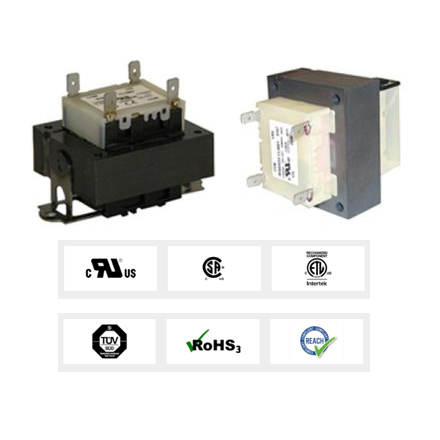
Sizing a transformer correctly is the difference between a reliable system and one plagued by overheating, “chattering” relays, or premature failure.
For low-voltage applications such as HVAC controls, doorbells, landscape lighting, or industrial control panels, you’ll often use a Class 2 transformer – which is safety-limited to a maximum of 100 VA and 24V output.
Class 2 transformers can be inherently limited, where the transformer’s design restricts current, or non-inherently limited,which require external overcurrent protection to comply with Class 2 rules.
This guide will show you how to calculate your power needs and select the right transformer size for your project.
1. Understanding VA in Transformers
VA (Volt-Amps) represents the transformer’s apparent power capacity. Unlike watts, which measure real power, VA accounts for the extra energy needed to push current through inductive loads like motors, solenoids, or relays.
Formula:
VA=Volts×Amps
What Makes Class 2 Transformers Special
- Safety-limited to 100 VA max
- Secondary voltage typically 12V or 24V
- Designed for low-voltage control circuits
These limits ensure the transformer remains safe even in smaller panels or residential settings.
2. Identify Secondary Voltage
Start by noting the voltage required by your devices:
- HVAC controls → 24V is standard
- Doorbells → 12V or 16V
- Landscape lighting → typically 12V
This voltage will be used in your VA calculation.
3. Calculate Total Current
List all devices connected to the transformer and their current draw:
- Relays
- Contactors
- Sensors
- PLC input modules
- Solenoids
- LED zones
Example: Multi-Device Load in an Industrial Panel
| Device | Voltage | Current |
| Relay (3 units) | 24V | 0.4A each |
| PLC Module | 24V | 0.8A |
| Sensors (2) | 24V | 0.2A each |
Step 1: Add the currents:
(0.4×3)+0.8+(0.2×2)=2.4A
4. Calculate VA
Multiply total current by voltage:
24V×2.4A=57.6VA
This is the minimum VA your transformer must supply.
5. Factor in the Safety Margin
Step 1: The 80% Rule
- Continuous loads (devices running 3+ hours) should not exceed 80% of the transformer’s VA rating.
- Inductive devices like motors or solenoids draw higher startup currents (inrush current).
Step 2: Divide the calculated VA by 0.8:
57.6÷0.8=72VA
6. Selecting the Correct Class 2 Size
Standard Class 2 sizes: 20 VA, 40 VA, 50 VA, 75 VA, 100 VA
Rules for Selection:
- Round up to the next standard size – don’t pick the exact VA.
- Check primary voltage – ensure it matches your supply (e.g., 120V or 240V). Multi-tap models may require selecting the correct lead.
- Plan for growth – if you might add more zones or devices later, a slightly larger transformer saves future replacement costs.
Quick VA Selection Table (24V Example)
| Total Current | Calculated VA | Recommended Transformer |
| 1A | 24 VA | 40 VA |
| 2A | 48 VA | 60 VA |
| 3A | 72 VA | 75 VA |
| 4A | 96 VA | 100 VA |
Remember: Class 2 transformers cannot exceed 100 VA. For higher loads, use a general industrial control transformer.
7. Physical Sizing & Mounting Considerations
Higher VA → larger transformer core and windings:
- Check panel space
- Consider mounting type (foot-mount, plate-mount, DIN rail)
- Ensure proper ventilation
A properly sized transformer runs cooler and lasts longer.
8. Common Sizing Mistakes to Avoid
- Selecting exactly the calculated VA without a safety margin
- Ignoring inrush currents for motors and solenoids
- Not accounting for multiple simultaneous loads
- Forgetting future expansion needs
- Confusing watts with VA on inductive loads
9. Practical Industrial Example
Scenario: Industrial panel with:
- 4 relays (0.5A each)
- 1 solenoid (1A)
- 2 sensors (0.25A each)
Total current:
(0.5×4)+1+(0.25×2)=3.5A
VA calculation:
24V×3.5A=84VA
With 25% safety margin:
84×1.25=105VA
10. Transformer Selection Checklist
✔ Confirm output voltage
✔ Add total load currents
✔ Multiply volts × amps → VA
✔ Apply 20–30% safety margin
✔ Ensure VA ≤ 100 for Class 2
✔ Check primary voltage
✔ Verify UL / NEC compliance
✔ Confirm panel space and ventilation
Conclusion
Calculating VA and selecting the right Class 2 transformer ensures:
- Stable voltage output
- Reliable operation of relays, sensors, and solenoids
- Longer transformer life
- Safer electrical systems
By following these steps, you can confidently size transformers for HVAC controls, landscape lighting, or industrial control panels, while staying compliant with UL and CSA standards.
FAQs – Class 2 Transformer VA & Sizing
1. What is a Class 2 transformer?
A low-voltage transformer with a maximum of 100 VA and 30V output, used for control circuits and small industrial applications.
2. How do I calculate transformer VA?
VA = Voltage × Total Current. Add all device currents and multiply by the secondary voltage.
3. Why add a safety margin?
To handle continuous loads and inrush current, prevent overheating, and extend transformer life.
4. What are standard Class 2 sizes?
20, 40, 50, 75, 100 VA. Always round up to the next size above your calculated VA.
5. Can I exceed 100 VA with Class 2?
No. For loads above 100 VA, use a general industrial control transformer or multiple Class 2 transformers.
6. Do watts equal VA?
Only for resistive loads. For inductive devices like motors or solenoids, VA is higher than watts.
7. How do I account for multiple devices?
Sum all device currents, multiply by voltage, add a safety margin, and pick the next standard size.
Ready to select your Class 2 transformer? At PowerVolt Group, we offer a full range of 10VA – 100VA Class 2 transformers designed for HVAC, control panels, and industrial applications.
Need expert guidance? Contact the PowerVolt Group engineering team to ensure you choose the perfect transformer for your project.