



Core Types in Power Transformers: Laminated, Toroidal, and Ferrite Cores
 February 20, 2026
Power transformers are the backbone of modern electrical systems, ensuring safe and efficient voltage conversion across industrial, commercial, and utility applications.
While ratings like kVA, voltage class, and efficiency often get the spotlight, the transformer core type plays an equally critical role in performance, losses, size, and cost.
At Powervolt Group, we help OEMs, contractors, and industrial buyers select the right transformer core design to maximize efficiency, reliability, and long-term ROI.
This article is part of our in-depth pillar resource:
Power Transformers: Complete Guide to Types, Applications, Ratings & Maintenance
If you want a comprehensive understanding of transformer selection, compliance standards, cooling methods, insulation classes, and maintenance best practices, explore our complete guide.
Understanding Transformer Core Types
The transformer core is responsible for carrying magnetic flux between primary and secondary windings. The material, construction method, and geometry of the core directly influence:
- Core losses (hysteresis & eddy current losses)
- Energy efficiency
- Heat generation
- Noise levels
- Electromagnetic interference (EMI)
- Overall system reliability
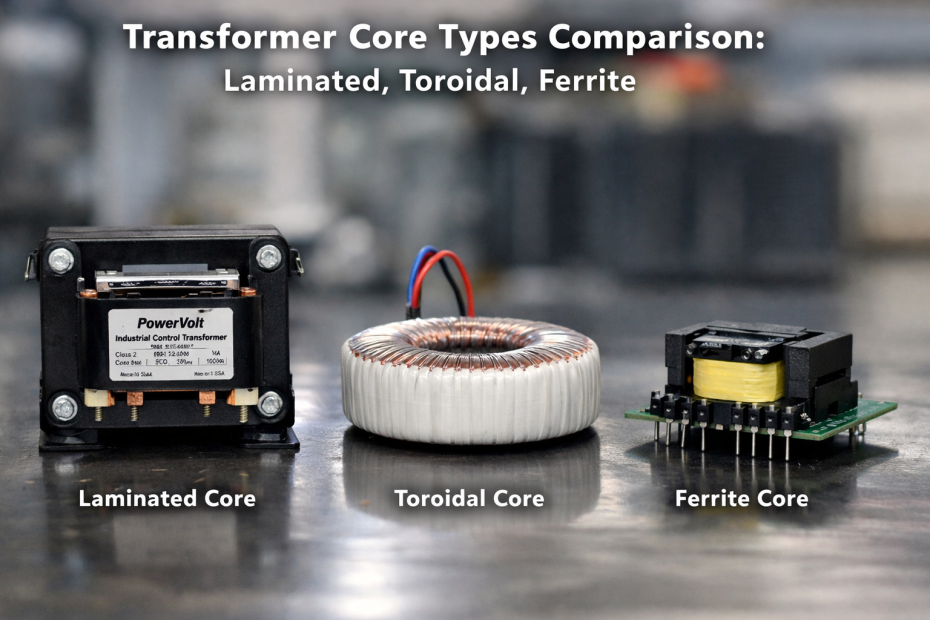
The three most common core types used in power transformers are:
- Laminated cores
- Toroidal cores
- Ferrite cores
1. Laminated Core Transformers
Laminated cores are the most widely used in conventional 50/60 Hz power transformers. They are constructed using thin silicon steel sheets stacked together to minimize eddy current losses.
How Laminated Cores Work
Each steel lamination is insulated from adjacent sheets to reduce circulating currents. These laminations are assembled in E-I or U-I configurations, forming a strong and efficient magnetic path.
Key Advantages
- Suitable for high kVA ratings
- Cost-effective manufacturing
- Strong mechanical durability
- Reliable for continuous industrial operation
Common Applications
- Distribution transformers
- Industrial power systems
- Motor control panels
- Heavy machinery
Limitations
- Larger physical size
- Higher magnetic leakage compared to toroidal designs
Best for: Heavy-duty industrial and utility power distribution systems.
2. Toroidal Core Transformers
Toroidal transformers feature a circular, ring-shaped magnetic core with windings distributed evenly around the core.
How Toroidal Cores Work
The continuous magnetic path minimizes flux leakage and improves magnetic efficiency, resulting in lower energy losses and quieter operation.
Key Advantages
- Higher efficiency
- Reduced electromagnetic interference
- Compact and lightweight
- Lower audible hum
Common Applications
- Medical devices
- Audio equipment
- Renewable energy systems
- Laboratory instruments
Limitations
- Higher production cost
- More complex winding process
Best for: Applications requiring compact size, low noise, and improved efficiency.
3. Ferrite Core Transformers
Ferrite cores are made from ceramic magnetic materials composed of iron oxide and other metallic elements. They are primarily used in high-frequency transformer applications.
How Ferrite Cores Work
Ferrite materials offer high electrical resistance, which significantly reduces eddy current losses at high switching frequencies.
Key Advantages
- Excellent for high-frequency switching
- Lightweight and compact
- Low core losses in SMPS
- Ideal for electronic power conversion
Common Applications
- Switch-mode power supplies (SMPS)
- Inverters
- Battery chargers
- Telecom equipment
Limitations
- Not suitable for high-power 50/60 Hz systems
- Lower mechanical strength than laminated steel
Best for: High-frequency electronic and power conversion systems.
Laminated vs Toroidal vs Ferrite: Comparison
| Feature | Laminated Core | Toroidal Core | Ferrite Core |
| Frequency | 50/60 Hz | 50/60 Hz | High-frequency |
| Efficiency | Moderate | High | Very High (HF) |
| Size | Large | Compact | Very Compact |
| EMI | Moderate | Low | Low |
| Typical Use | Industrial Power | Precision Systems | SMPS & Electronics |
How to Select the Right Transformer Core
When choosing a transformer core type, evaluate:
- Operating frequency
- Power rating (kVA)
- Load characteristics
- Space constraints
- Noise sensitivity
- Energy efficiency targets
- Industry compliance standards
At Powervolt Group, we engineer transformer solutions that align with your operational requirements, environmental conditions, and long-term performance goals.
Frequently Asked Questions (FAQs)
1. Which core type is best for industrial power transformers?
Laminated silicon steel cores are generally best suited for industrial power transformers operating at standard grid frequencies (50/60 Hz).
2. Are toroidal transformers more energy-efficient?
Yes. Due to their closed magnetic path, toroidal transformers typically provide higher efficiency and lower magnetic leakage compared to laminated cores.
3. Why are ferrite cores preferred in SMPS?
Ferrite cores minimize eddy current losses at high switching frequencies, making them ideal for switch-mode power supplies and inverter systems.
4. How does core material impact transformer performance?
Core material directly affects hysteresis losses, eddy current losses, temperature rise, and overall efficiency.
5. Does Powervolt Group offer custom transformer core configurations?
Yes. Powervolt Group provides custom-engineered laminated, toroidal, and ferrite core transformer solutions designed for OEMs, industrial facilities, and specialized applications.
Why Choose Powervolt Group?
- Industry-compliant transformer manufacturing
- Custom design capabilities
- High-quality materials and precision engineering
- Reliable B2B supply for industrial and commercial sectors
- Technical support from design to deployment
Ready to Optimize Your Transformer Design?
Whether you need a high-capacity laminated core transformer, a compact toroidal solution, or a high-frequency ferrite design, Powervolt Group delivers performance-driven, application-specific transformer systems.
Contact Powervolt Group today to discuss your project requirements and receive a customized transformer solution built for efficiency, safety, and long-term reliability.