






Power Transformer Ratings Explained: kVA, Voltage, Frequency & Impedance
 February 24, 2026
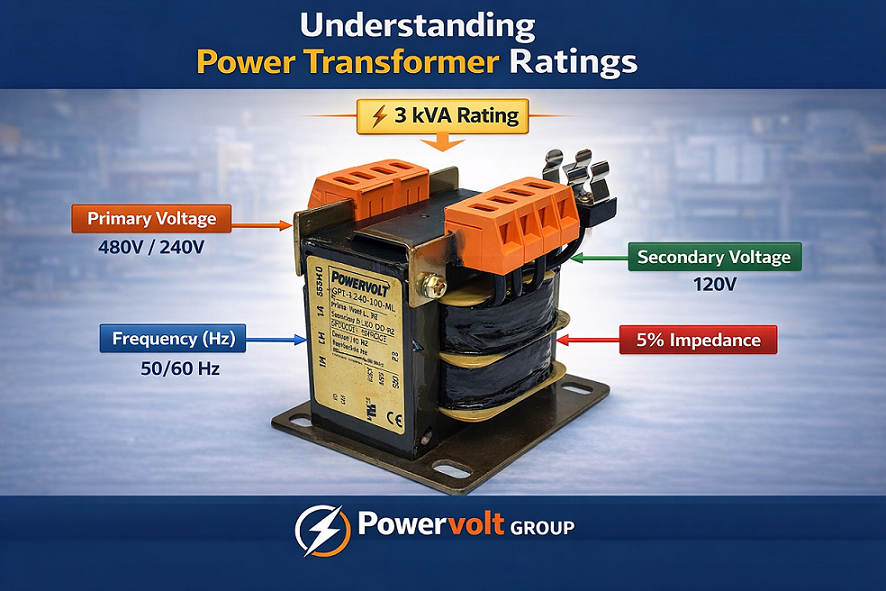
Power transformers are the backbone of electrical transmission and industrial power systems. Whether used in utilities, renewable energy plants, or heavy industries, selecting the right transformer depends heavily on understanding its ratings.
In this guide, we break down the four most critical transformer ratings – kVA, Voltage, Frequency, and Impedance – to help engineers, procurement teams, and decision-makers choose the right solution for their application.
For a broader technical understanding, you can also explore our detailed pillar guide:
Power Transformers: Complete Guide to Types, Applications, Ratings & Maintenance
covering everything from transformer classifications to lifecycle maintenance strategies.
As a trusted manufacturer of industrial transformers, Powervolt Group ensures every transformer is designed with precision ratings for safety, efficiency, and long-term reliability.
Understanding Power Transformer Ratings
Transformer ratings define the operational limits under which a transformer performs safely and efficiently. The four primary ratings include:
- kVA (Power Capacity)
- Voltage (Primary & Secondary)
- Frequency (Hz)
- Impedance (%)
Let’s break them down in detail.
1. kVA Rating (Kilovolt-Ampere)
The kVA rating indicates the maximum apparent power a transformer can handle without overheating.
What is kVA?
kVA (Kilovolt-Ampere) represents the transformer’s load-handling capacity under rated conditions.
Formula:
kVA = (Voltage × Current) ÷ 1000
Why kVA Matters
- Determines transformer size
- Prevents insulation breakdown
- Supports load expansion planning
- Ensures long service life
Example
If a transformer is rated 1000 kVA, it can safely supply 1000 kVA continuously under specified operating conditions.
⚡ Pro Tip: Select a transformer with 10–20% higher kVA capacity than your current load to accommodate future growth.
2. Voltage Rating (Primary & Secondary Voltage)
The voltage rating defines the input voltage (primary side) and output voltage (secondary side).
Primary Voltage
The supply voltage from the grid or generator.
Secondary Voltage
The voltage delivered to equipment or distribution panels.
Why Voltage Rating is Critical
- Must match system design
- Prevents equipment damage
- Ensures stable voltage regulation
- Maintains operational efficiency
Example
A transformer rated:
- Primary: 11 kV
- Secondary: 415 V
This means it steps down 11,000 volts to 415 volts for industrial distribution systems.
Incorrect voltage selection can lead to overheating, inefficiency, or complete system failure.
3. Frequency Rating (Hz)
The frequency rating indicates the grid frequency the transformer is designed to operate on.
Common standards:
- 50 Hz (India, Europe, Asia)
- 60 Hz (USA, North America)
Why Frequency Matters
Operating a transformer at the wrong frequency can cause:
- Core saturation
- Excessive heating
- Increased losses
- Reduced efficiency
For example:
- A 50 Hz transformer can typically operate safely on 60 Hz.
- A 60 Hz transformer used on 50 Hz may overheat due to higher magnetic flux.
At Powervolt Group, transformers are engineered specifically for regional frequency standards to ensure optimal performance and durability.
4. Impedance Rating (% Impedance)
The impedance rating is expressed as a percentage and indicates internal resistance under short-circuit conditions.
What Does % Impedance Represent?
It shows how much voltage is required to circulate full-load current during a short circuit.
Why Impedance is Important
- Controls short-circuit current
- Affects voltage drop under load
- Enables safe parallel operation
- Impacts protection coordination
Example
A transformer with 6% impedance requires 6% of rated voltage to produce full-load current during a short circuit.
Higher impedance:
- Lower fault current
- Improved protection safety
Lower impedance:
- Higher fault current
- Better voltage regulation
Selecting the correct impedance rating is essential in industrial environments with high fault levels.
How These Ratings Work Together
| Rating | Function | System Impact |
| kVA | Load Capacity | Prevents overheating |
| Voltage | Energy Conversion | Equipment compatibility |
| Frequency | Core Design Parameter | Efficiency & losses |
| Impedance | Fault Current Control | Protection & safety |
Understanding these combined ratings ensures:
✔ Proper transformer sizing
✔ Energy-efficient operation
✔ Compliance with electrical standards
✔ Reduced downtime and maintenance
For a deeper technical breakdown of transformer types and lifecycle management, refer to our pillar resource:
Power Transformers: Complete Guide to Types, Applications, Ratings & Maintenance
Common Mistakes in Transformer Rating Selection
- Choosing exact kVA without load margin
- Ignoring voltage fluctuation tolerance
- Overlooking frequency compatibility
- Selecting incorrect impedance for system fault levels
- Not considering cooling class and ambient temperature
Partnering with an experienced manufacturer like Powervolt Group eliminates these risks.
Why Choose Powervolt Group?
Powervolt Group specializes in manufacturing high-performance:
- Power Transformers
- Distribution Transformers
- Control Transformers
- Custom-engineered electrical solutions
Our transformers feature:
✔ Optimized laminated core design
✔ Precision copper/aluminum windings
✔ Tested impedance levels
✔ High thermal endurance insulation
✔ Compliance with IEC & IS standards
Frequently Asked Questions (FAQs)
1. What is the most critical rating in a power transformer?
kVA rating is crucial because it defines the load capacity. However, voltage, frequency, and impedance must also match system requirements.
2. How do I calculate required transformer kVA?
kVA = kW ÷ Power Factor
Example: 500 kW load at 0.8 PF = 625 kVA transformer required.
3. Can I operate a 60 Hz transformer on 50 Hz?
Not recommended. It may cause magnetic saturation and overheating.
4. What happens if transformer impedance is too low?
It increases short-circuit current, which may damage equipment and protection devices.
5. Does higher kVA improve performance?
Not necessarily. Oversizing increases cost and reduces efficiency under light load.
6. Why is frequency rating important?
Frequency affects core design and magnetic flux. Wrong frequency reduces efficiency and increases heat.
Conclusion
Understanding kVA, Voltage, Frequency, and Impedance ratings is essential for selecting the right power transformer for industrial, commercial, or utility applications.
Incorrect ratings can cause overheating, energy losses, system instability, and premature failure.
If you need expert consultation or customized transformer solutions, connect with Powervolt Group today.
Get Reliable & Efficient Transformer Solutions
Contact Powervolt Group now for precision-engineered power transformers built for performance, safety, and long-term reliability.