





Wiring and Installation Tips for Class 2 Transformers
 February 5, 2026
Best Practices for Safe, Code-Compliant, and Reliable Performance
Class 2 transformers are widely used in industrial, commercial, and residential applications because they provide low-voltage, inherently energy-limited power that meets strict safety standards.
However, even the highest-quality transformer can fail to deliver reliable performance if wiring and installation best practices are not followed.
This article is part of our broader resource, “Class 2 Transformers: Complete Guide to Selection, Safety, and Applications,” created by Powervolt Group to help professionals make informed, code-compliant decisions across every stage—from selection to installation.
What Are Class 2 Transformers?
A Class 2 transformer is specifically designed to limit voltage and power output under fault conditions, significantly reducing the risk of electrical shock and fire. These transformers comply with NEC Article 725 and are commonly used in:
- HVAC control systems
- Building automation systems (BAS)
- Access control and security systems
- LED lighting and signage
- Doorbells and alarm circuits
For a deeper understanding of transformer types, safety classifications, and real-world use cases, refer to our pillar guide:
Class 2 Transformers: Complete Guide to Selection, Safety, and Applications
Pre-Installation Checklist
Before installing a Class 2 transformer, confirm the following:
- Primary voltage compatibility (120V, 208V, 240V, 480V)
- Correct VA rating based on connected load
- UL / CSA recognition
- Manufacturer wiring diagram reviewed
- Installation environment meets ventilation and temperature requirements
Powervolt Group Tip: Always design with a 20–25% VA safety margin to prevent overheating and voltage drop.
Best Wiring Practices for Class 2 Transformers
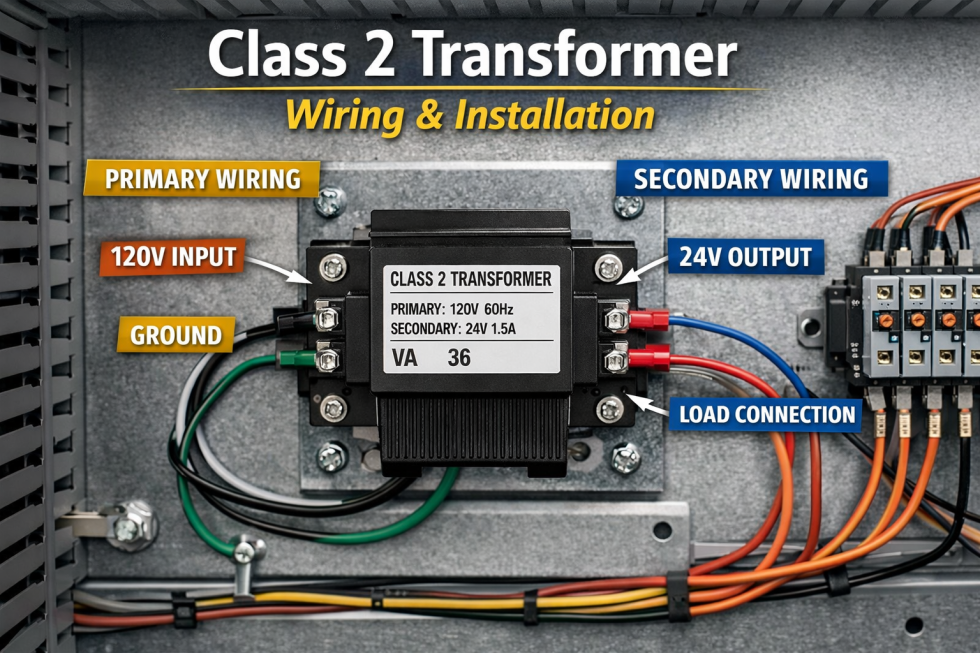
1. Follow Terminal Identification and Wiring Diagrams
Clearly distinguish between primary (line voltage) and secondary (low voltage) terminals. Never rely on assumptions-always follow the manufacturer’s wiring diagram.
2. Select the Correct Wire Gauge
Improper wire sizing can lead to performance issues even in low-voltage circuits.
- Short cable runs → 18 AWG
- Longer runs or higher current → 16 AWG or larger
Wire size should be selected based on distance, load current, and voltage drop calculations.
3. Maintain NEC-Compliant Circuit Separation
According to NEC Article 725, Class 2 circuits must remain separate from Class 1 or high-voltage conductors unless specific conditions are met.
This separation improves:
- Electrical safety
- Signal integrity
- Inspection approval rates
4. Grounding and Bonding Considerations
While Class 2 secondary circuits typically do not require grounding:
- Primary-side grounding must follow NEC and local codes
- Metal enclosures must be properly bonded
Always follow manufacturer recommendations.
5. Prevent Transformer Overloading
Overloading is one of the most common causes of Class 2 transformer failure.
Symptoms include:
- Excessive heat
- Output voltage drop
- Shortened transformer lifespan
Correct load calculation is a core principle discussed in Class 2 Transformers: Complete Guide to Selection, Safety, and Applications.
Installation Best Practices
Proper Mounting
- Install on stable, vibration-free surfaces
- Use wall-mount or DIN-rail options where applicable
- Avoid proximity to heat sources
Ensure Adequate Ventilation
Even energy-limited transformers generate heat. Adequate airflow ensures consistent output and long service life.
Common Wiring and Installation Mistakes to Avoid
- Mixing Class 2 and high-voltage wiring
- Ignoring VA load calculations
- Installing in sealed or unventilated enclosures
- Using incorrect primary voltage
- Skipping NEC compliance checks
Avoiding these errors helps ensure safe, long-term operation.
Why Choose Powervolt Group?
Powervolt Group manufactures and supplies UL-recognized, NEC-compliant Class 2 transformers engineered for reliability across industrial, commercial, and building automation applications.
Our technical team supports customers throughout the entire lifecycle-from selection guidance to installation best practices aligned with our pillar resource, Class 2 Transformers: Complete Guide to Selection, Safety, and Applications.
FAQs: Wiring and Installation of Class 2 Transformers
Q1. Do Class 2 transformers require secondary overcurrent protection?
No. Class 2 transformers are inherently energy limited and typically do not require additional secondary protection.
Q2. Can Class 2 wiring share a conduit with line voltage?
In most cases, no. NEC restricts this unless specific code conditions are satisfied.
Q3. What happens if a Class 2 transformer is overloaded?
Overloading can cause overheating, voltage drop, and premature failure.
Q4. Are Class 2 transformer secondary circuits grounded?
Usually no, unless required by the application or local code.
Q5. How do I select the correct VA rating?
Add the VA of all connected loads and include a 20–25% safety margin.
Final Thoughts
Proper wiring and installation are critical to the safety and performance of Class 2 transformers. When combined with the right product selection, they ensure code compliance and long-term reliability.
Looking for High-Quality Class 2 Transformers?
Partner with Powervolt Group for reliable, compliant Class 2 transformer solutions and expert technical support.